
Cold Work Tool Steel
Cold Work Tool Steels are a group of high-performance steels specifically designed for tooling applications that operate at room temperature or slightly elevated temperatures, typically below 200°C. These steels are widely used in industries where precision cutting, shaping, and forming of materials are required without the application of heat. Their superior hardness and wear resistance make them ideal for producing durable tools that maintain accuracy over long production cycles.
One of the most important characteristics of hot work steels is their excellent resistance to thermal fatigue and heat checking. This ensures longer service life and reduced risk of cracking or deformation during continuous heating and cooling operations. Chromium-based grades such as H11 and H13 are among the most commonly used due to their balanced properties of toughness, wear resistance, and high-temperature strength. Tungsten-based grades like H21 are preferred for applications requiring exceptional hot hardness and resistance to prolonged heat exposure. One of the primary advantages of cold work tool steels is their exceptional resistance to wear and abrasion. High-carbon, high-chromium grades such as D2 and D3 are especially valued for their ability to retain sharp cutting edges and withstand continuous friction. Air-hardening grades like A2 offer excellent dimensional stability with minimal distortion during heat treatment, making them suitable for precision tooling applications.
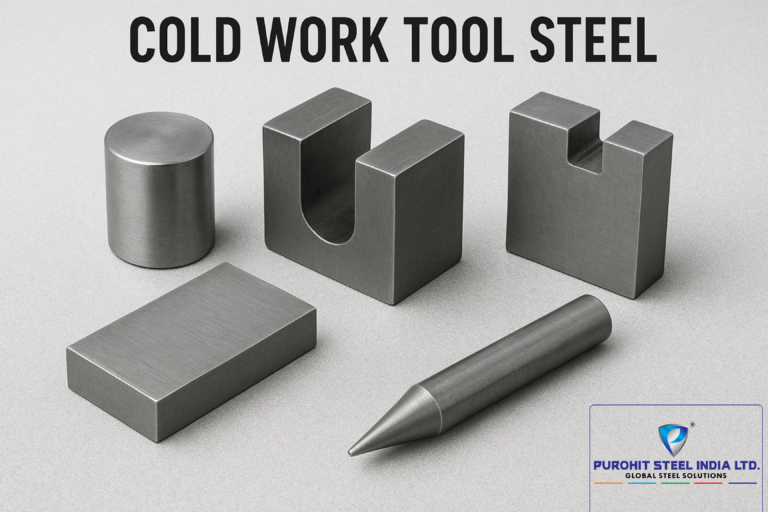
Oil-hardening grades such as O1 and O2 are known for their toughness and ease of machining, making them a cost-effective solution for general-purpose tooling. These steels provide a balanced combination of hardness and impact resistance, ensuring reliable performance in various manufacturing environments. Additionally, their deep hardenability allows uniform hardness throughout the material section.
Cold work tool steels are extensively used in automotive, sheet metal, fastener manufacturing, and heavy engineering industries. Their ability to maintain dimensional accuracy, resist deformation, and deliver long service life makes them a critical material for punches, dies, shear blades, and forming tools used in high-volume production.
Key Properties
- High wear and abrasion resistance
- High compressive strength
- Maintains hardness at room temperature
- Good toughness (grade dependent)
- High dimensional stability during heat treatment
- Long service life in heavy-duty applications
Grade
Common Applications
- Punches and dies
- Shear blades
- Cold forging dies
- Wire drawing dies
- Rolling dies
- Reamers, broaches, and milling cutters
- Guillotine knives
- Forming tools
- Master tools and gauges